Camper Vans, Honestly: Life in a Class B
The camper van is the most desirable vehicle in the RV world and the smallest. Whether that combination suits you depends on how you travel.

- A camper van drives and parks like a large car, which is its greatest advantage.
- It is the most expensive motorhome for the space you get. Storage, water and bathroom facilities are all small.
- It suits one or two people who move often. Rent one for a long weekend before you consider buying.
There is something irresistible about a camper van. It promises a home you can park anywhere, a kitchen with a view that changes daily and the freedom to leave on a Friday with no plan at all.
The promise is real. So are the compromises, and photographs taken at sunset tend to leave those out. This is an attempt at the full picture.
What a Class B is
In the motorhome world, camper vans are known as Class B. They are built within the body of a full-size van, which keeps them between about 17 and 23 feet long.
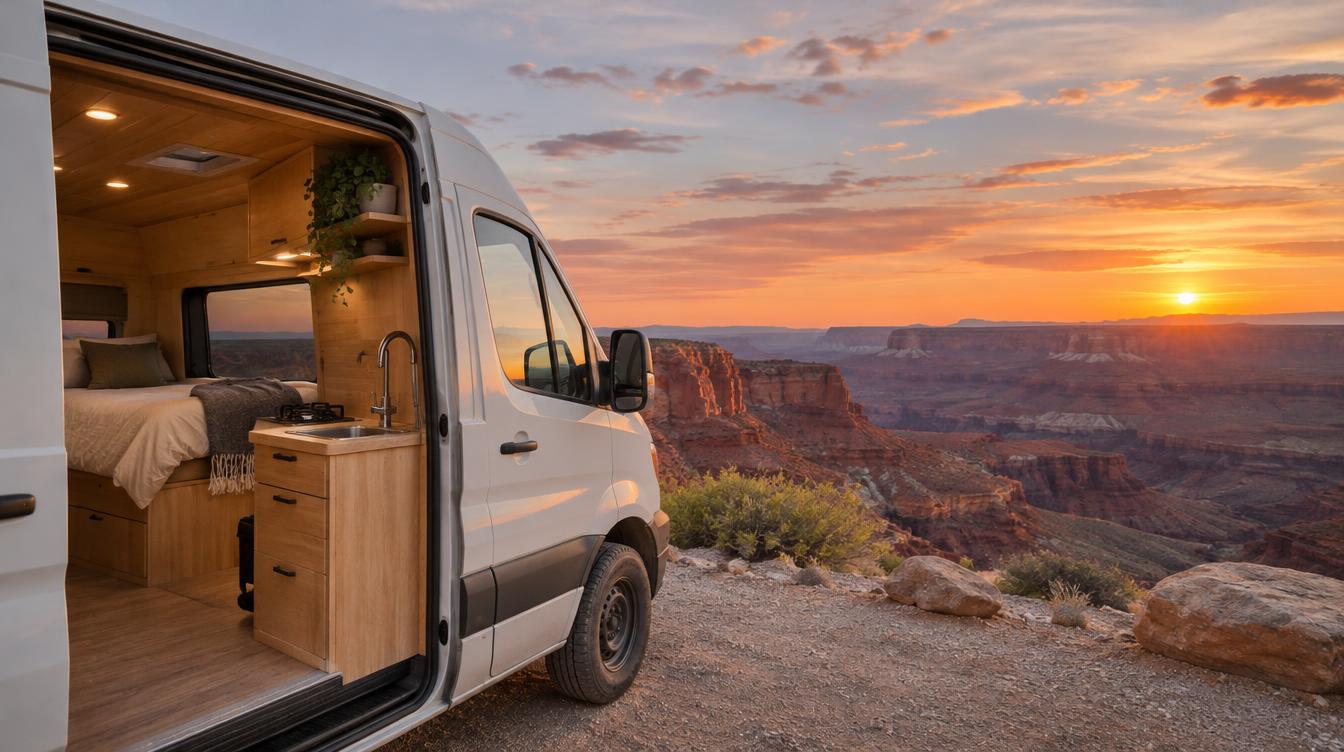
Inside that shell is a bed, a galley with a hob, sink and fridge, some seating and, in many models, a small bathroom. Everything is designed to do two jobs.
| Feature | Class B camper van | Class C motorhome |
|---|---|---|
| Length | 17 to 23 ft | 20 to 33 ft |
| Sleeps comfortably | 2 | 4 to 6 |
| Parking | Standard space, most car parks | Needs larger spaces |
| Fuel economy | Roughly 15 to 22 mpg | Roughly 8 to 13 mpg |
| Bathroom | Small wet bath, or none | Separate shower in many |
| Price for the space | Highest | Moderate |
The great advantage: it goes anywhere
A camper van is the only motorhome most people can drive without thinking about it. It fits a normal parking space, a supermarket car park and most city streets.
That changes how you travel. You can stop in a town for lunch, take a narrow road to a trailhead or visit a friend without planning where to leave a 30-foot vehicle.
It also fits almost every campsite, including the smaller, prettier ones that larger rigs cannot use.
A big motorhome takes you to the campground. A van takes you everywhere else as well.
Fuel and running costs
Vans are considerably more economical than larger motorhomes, typically returning somewhere between 15 and 22 miles per gallon depending on engine and load.
Servicing is done at ordinary commercial vehicle garages, tires are standard sizes and many owners use the van as a second vehicle between trips.
The space
Interior floor area is comparable to a small bathroom at home. Two people can live in it happily. Two people cannot comfortably pass each other in it.
Bad weather is the test. A rainy day in a van means two people, one small space and nowhere to go. Couples who thrive in vans tend to be good at giving each other room.
Beds
The bed is the most important layout decision. A fixed bed is always made and ready, and it takes up a large part of the van permanently.
A convertible bed folds away into seating or a table, giving more daytime space at the cost of making and unmaking it every day. Pop-top roofs add a second sleeping area and standing room in shorter vans.
Lie on the bed before you commit. Tall people should check the length carefully, particularly in vans where the bed runs across the width.
Kitchen and bathroom
Galleys are compact and capable: usually two burners, a small sink and a fridge. Counter space is minimal, so much cooking happens outside when the weather allows.
Many vans include a wet bath, a single small compartment that serves as both toilet and shower. Others have a cassette toilet stored in a cupboard, or none. Our guide to small campers with bathrooms explains the options.
Water and power
Water tanks are small, typically 20 to 30 gallons of fresh water. Two careful people can make that last three or four days.
Modern vans usually rely on lithium batteries charged by the engine, by solar panels on the roof and by plugging in at a campsite. That is enough for lights, a fridge, fans and device charging.
Air conditioning is the difficult one. Running it from batteries for long is demanding, so check exactly how a van's system is intended to be used if you camp in hot places.
- Fresh water tank capacity, and how it is filled.
- Battery capacity and how it is recharged.
- Whether the heater runs on fuel, propane or electricity.
- Whether tanks and pipes are protected from freezing.
Storage
Storage is the constraint owners mention most. There is room for clothes, food and a few pieces of equipment, and little else.
Bikes go on a rack at the back. Kayaks go on the roof. Bulky gear requires choices. People who enjoy vans tend to enjoy owning less.
The price
Camper vans are expensive, often costing as much as or more than a much larger motorhome. You are paying for the engineering required to fit a home into a van, and for strong demand.
Used vans hold their value well, which softens the cost of ownership and makes bargains rare.
Factory-built or converted
Factory-built vans come from established RV manufacturers, with warranties, tested systems and dealer support.
Custom conversions range from superb to worrying. If you consider one, ask who built it, how the electrical and gas systems were installed and whether it can be insured and serviced without difficulty.
Who it suits
A camper van suits one or two people who like to keep moving, who prefer towns, trailheads and small campsites to resort-style RV parks, and who value driving ease over indoor space.
It suits less well families, people who stay in one place for weeks, and anyone who wants a full bathroom or generous storage.
Who should look elsewhere
If you need to sleep four, a Class C motorhome or a travel trailer gives far more room for less money. If you want to leave camp set up and drive off for the day, a trailer and tow vehicle may suit you better.
The honest verdict
A camper van is a wonderful way to travel and a demanding place to live. It asks you to carry less, plan your water and get along in close quarters.
For the right people, those are not sacrifices at all. They are the point.
Frequently asked questions
What is a Class B RV?
A Class B is a motorhome built inside a standard van body, commonly called a camper van. It is typically between 17 and 23 feet long and contains a bed, a small kitchen and often a compact bathroom.
Can you live in a camper van full time?
Some people do, most often singly or as a couple. It requires a minimalist approach to possessions, regular stops for water and waste, and a tolerance for a very small space in bad weather. Most owners use them for trips, not as a permanent home.
Are camper vans good in winter?
Some are built with extra insulation, heated tanks and efficient heaters for cold weather, and others are not. If you plan to camp below freezing, check specifically for four-season features and ask how the water system is protected.